Picks one of the 7140 colour gradients at random and returns it, optionally printing its name so you can re-use it later. Based on Google's "I'm Feeling Lucky" button.
lucky(
  n = 100,
  colorRampPalette = FALSE,
  rev = FALSE,
  message = TRUE,
  nseed,
  frgb = rep(1, 3)
)
Arguments
- n
Integer. Number of colours to return when
colorRampPalette = FALSE. Ignored whencolorRampPalette = TRUE.- colorRampPalette
Logical. If
FALSE(default), returns a character vector ofncolours. IfTRUE, returns acolorRampPalettefunction — the right choice forplotand ggplot2.- rev
Logical. If
TRUE, reverse the gradient order.- message
Logical. If
TRUE(default), prints the name and index of the chosen palette to the console.- nseed
Integer. A seed value passed to
set.seedfor reproducible random selection.- frgb
Numeric vector of length 3. Per-channel scaling factors for
c(red, green, blue). Defaultc(1, 1, 1).
Value
A character vector of hex colours when
colorRampPalette = FALSE, or a colorRampPalette function
when colorRampPalette = TRUE.
Examples
library(cptcity)
# Random palette each time you call it
image(matrix(1:100), col = lucky())
#> Colour gradient: cmocean_gray, number: 577
 image(matrix(1:100), col = lucky())
#> Colour gradient: nd_vermillion_Analogous_08, number: 5957
image(matrix(1:100), col = lucky())
#> Colour gradient: nd_vermillion_Analogous_08, number: 5957
 image(matrix(1:100), col = lucky(rev = TRUE))
#> Colour gradient: jjg_polarity_PiYG, number: 4289
image(matrix(1:100), col = lucky(rev = TRUE))
#> Colour gradient: jjg_polarity_PiYG, number: 4289
 # Reproducible random pick
image(matrix(1:100), col = lucky(nseed = 42))
#> Colour gradient: pj_1_fe2, number: 6532
# Reproducible random pick
image(matrix(1:100), col = lucky(nseed = 42))
#> Colour gradient: pj_1_fe2, number: 6532
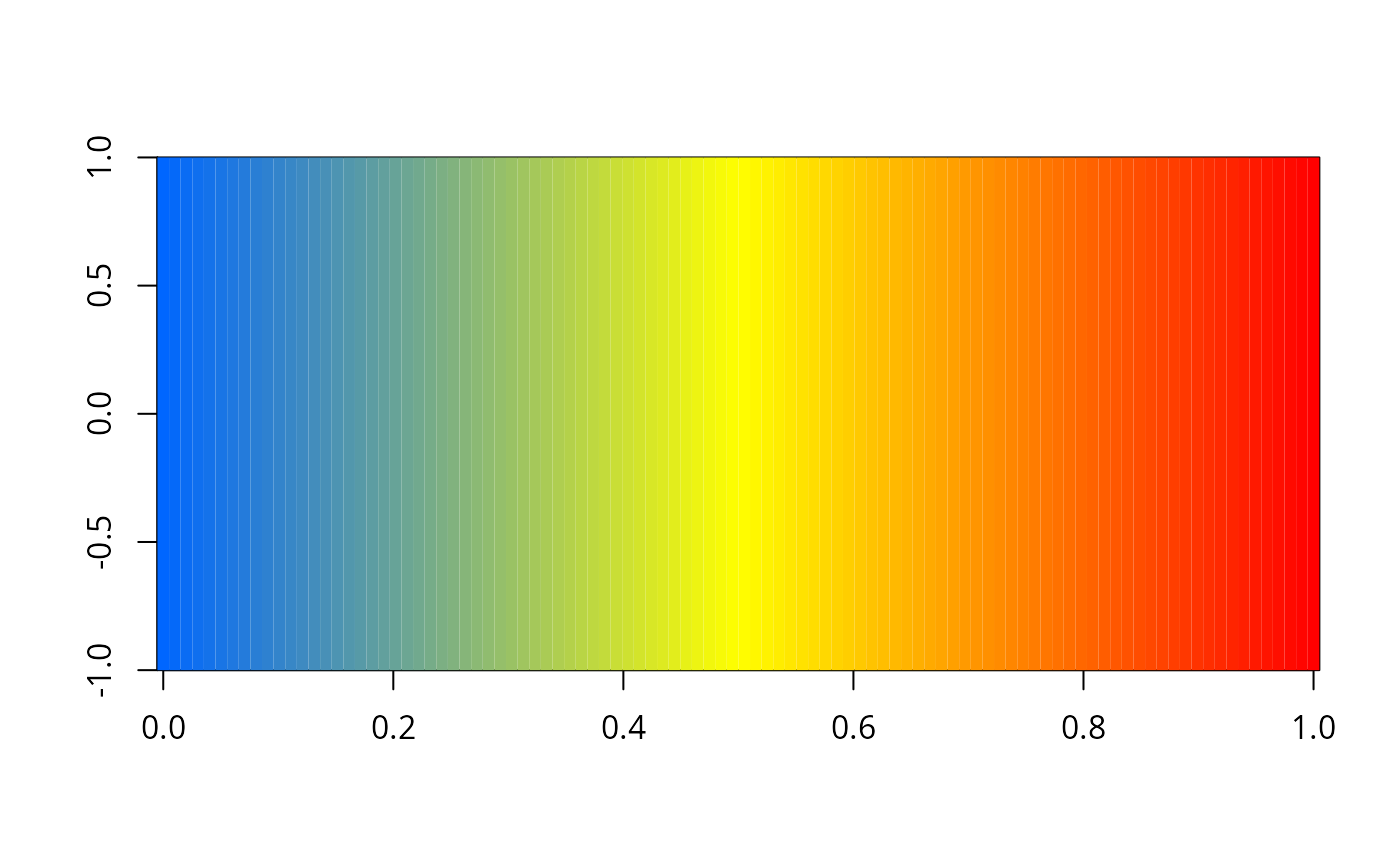 image(matrix(1:100), col = lucky(nseed = 42)) # same palette
#> Colour gradient: pj_1_fe2, number: 6532
# Silent mode + sf-compatible output
if (FALSE) { # \dontrun{
library(sf)
nc <- st_read(system.file("shape/nc.shp", package = "sf"))
plot(nc["AREA"], pal = lucky(colorRampPalette = TRUE, message = FALSE))
} # }
image(matrix(1:100), col = lucky(nseed = 42)) # same palette
#> Colour gradient: pj_1_fe2, number: 6532
# Silent mode + sf-compatible output
if (FALSE) { # \dontrun{
library(sf)
nc <- st_read(system.file("shape/nc.shp", package = "sf"))
plot(nc["AREA"], pal = lucky(colorRampPalette = TRUE, message = FALSE))
} # }